
Spirit Week is the biggest school pride event of the year — and also the one most likely to feel chaotic, underprepared, or unevenly executed without a clear plan behind it. Most schools already have the enthusiasm. What they need is the roadmap. Done right, Spirit Week builds camaraderie, lifts morale, and gives students and staff a shared experience that outlasts the week itself. Done without a plan, it’s five random days that fizzle out by Wednesday.
The best Spirit Week ideas combine a strategic mix of theme days (classic, creative, and wildcard), lunchtime activities that build momentum throughout the week, a well-stocked game-day concession stand, and early planning with a dedicated volunteer team. Sequencing matters as much as the ideas themselves. Start simple, build toward a big Friday finale, and track what works so next year’s team doesn’t start from scratch.
Here is your complete Spirit Week ideas playbook — themed dress-up days, lunchtime activities, game-day concession and spirit gear strategy, and the planning habits that make this year’s Homecoming Spirit Week better than last year’s, and easier to repeat next fall.
Choose Spirit Week Theme Days Students Will Get Excited About

Theme days are the backbone of Spirit Week. The right mix creates momentum that builds day by day toward the Friday finale, rather than a list of ideas thrown together with no logic connecting them.
The smartest Spirit Week ideas for school come from a simple selection framework: aim for variety across three categories — classic and safe, creative and specific, and wildcard and high-energy. Sequencing matters just as much as selection. Start with an accessible, low-barrier theme on Monday, like Pajama Day or School Color Day, then escalate toward the boldest theme of the week by Friday. Students need a warm-up before they commit to a full costume.
Here’s a curated list organized by category:
Classic/Safe
- Pajama Day
- School Color Day
- Sports Team Day
- College T-Shirt Day
- Twin Day
Creative/Specific
- Decade Day (50s, 60s, 70s, 80s, 90s)
- Favorite Movie Day
- Hollywood Day
- Wizard of Oz Day
- Western Day
- Star Wars Day
- International Day (assign a different country per class)
Wildcard/High-energy
- Wacky Hair Day
- Crazy Hat Day
- Wild Shoe Day
- Tie-Dye Day
- Alien Day
- Polka Dot Day
- Camo Day
Seasonal/Event-specific
- Hawaiian Day
- Beach Party Day
- Ugly Christmas Sweater Day (for a winter Spirit Week)
- Dress-Up Day
If you’re looking for unique spirit week ideas that drive participation rather than groans, promotion matters. Announce themes one week in advance with a printed or digital countdown. Students who know what’s coming prepare better, and they show up more excited when the day arrives.
Tips worth building into your plan:
- Track participation by class, not by individual student. A simple percentage-dressed scoreboard creates friendly competition without putting pressure on any one kid.
- Offer an alternative for students who can’t or don’t want to dress up. A school-color wristband or ribbon lets every student feel included without requiring a full costume change.
Keep Spirit Week Energy Going All Week

Lunchtime activities extend Spirit Week energy beyond the hallways and into the middle of the day, which is exactly when enthusiasm most commonly dips. Every lunchtime activity you plan should accomplish three things: maintain excitement, engage students who aren’t participating in theme days, and raise money for the school or booster club.
Lunch period activities work best when student-only participation is the goal, while after-school slots make more sense if you want parents and community members in the room too.
A smart way to sequence activities across the week might look something like this:
- Monday — low-barrier opener: Karaoke, Name That Tune, or a Trivia Contest. These get students talking and require no physical prep, which matches the lighter energy of the week’s first day.
- Tuesday/Wednesday — competitive middle: Tricycle Race, Tug of War, or an Obstacle Course. These give students a physical energy release right in the middle of the week, when attention spans start to wander.
- Thursday — crowd engagement and fundraising: Coin Drop, Guess the Number of Coins in a Jar, or Spin the Wheel with prizes. These raise money and build anticipation toward Friday.
- Friday — go big: A pep rally or tailgate party, grilling out in the parking lot before the big game. This is the most community-inclusive event of the week, and it should feel like the payoff for everything leading up to it.
Other activities worth working into the rotation: Baby Bottle Drinking Contest, Celebrity Name Game, Piñata, and Karaoke.
If fundraising is part of your goal, Coin Drops and Spin the Wheel are the easiest activities to monetize. Establish a clear cause students care about, and communicate it consistently throughout the week rather than just announcing it once. Don’t know how to run a fundraiser? Check out our How to Run a Successful School Fundraiser for easy tips and ideas.
Two logistics notes that save headaches later:
- Every activity needs at least two staff or booster club volunteers, so recruit before the week starts, not the morning of.
- When it comes to prizes, spirit gear wins every time. Wristbands, EyeBlacks, bandanas, and pom-poms are inexpensive, wearable, and immediately boost visible school spirit around the building.
Stock Your Concession Stand for the Homecoming Game
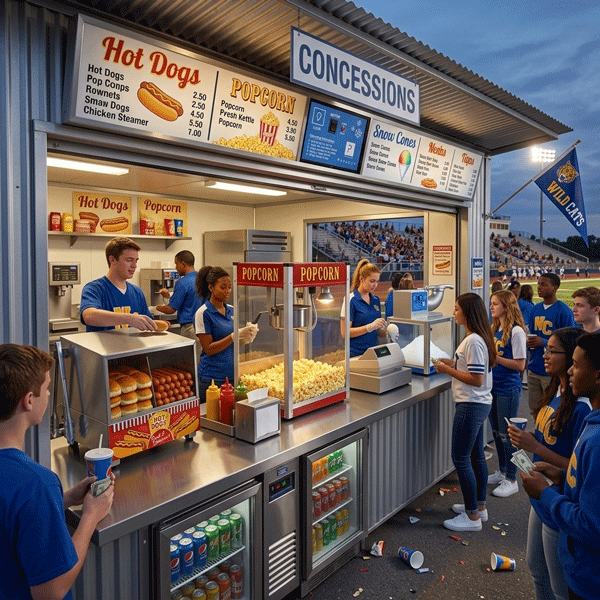
The Homecoming game is where Spirit Week lands. Everything the week built toward comes together here, and the concession stand is the operational engine that makes the night run smoothly — and profitably.
Before the game even starts, coordinate with the band, cheer team, and mascot on the half-time show well in advance. It’s the one moment every student, parent, and staff member in the stands will remember.
For the concession stand itself, plan to stock two categories: spirit merchandise and food.
Spirit merchandise (wearables and accessories):
- EyeBlacks — game-day must-haves; stock school color and mascot variants
- Poms and Spirit Shakers — high-visibility, crowd-activation items
- Spirit Wigs — limited quantity, event-specific, high impulse buy
- Spirit Jewelry — earrings and beads, a consistent seller especially with female students
- Bandanas — school color variants, gender-neutral with broad appeal
- Noisemakers — a stadium energy staple
- Seat Cushions — practical and spirit-branded, a strong parent and adult purchase
- T-shirts and Knitwear — higher price point, so stock limited quantities for end-of-game sales
Food and concession items:
- Sno Cones, Popcorn, and Cotton Candy — high-margin, fast-moving crowd staples
- Hot Dogs — the tailgate anchor; plan for volume
- Nachos — a fan favorite that requires more prep but sells consistently well
Placement matters more than most organizers think. Position wearable spirit items near the entry gate where students and families first arrive; impulse purchases happen in the first five minutes. Anchor food items in the center of the concession area instead. If volume allows, separate merchandise and food staffing entirely; a line for nachos should never slow down a wristband sale. Shop Anderson’s concession stand supplies and equipment for everything you need to make your concession stand successful.
Want to extend the event window? Consider a pre-game parking lot tailgate with grilling and early spirit gear sales. It captures families who arrive early and turns Homecoming into more of an all-afternoon event than a single game.
Boost School Pride Beyond Dress-up Days

Spirit Week doesn’t have to be purely cosmetic. Schools that use it to reinforce identity, celebrate diversity, and connect to community causes create the kind of lasting impact that dress-up days alone can’t match.
School pride programming:
- Extend Mascot Day beyond the pep rally costume. Involve your school mascot in classroom visits, hallway appearances, and photo stations throughout the week.
- For School Colors Day, go beyond the dress code. Coordinate a school-wide photo at a specific time. Students and staff members in school colors in the same frame becomes a powerful community artifact that outlasts the week itself.
Cultural appreciation:
- Assign countries to classes in advance for International Day, with a small research prompt attached. Students who know something about the country they’re representing participate more authentically.
- Invite students to share cultural traditions, foods, or music during lunchtime activities. It turns a dress-up day into a genuine learning moment instead of just a costume exercise.
Community involvement and cause-marketing:
- Pink Out Day is one of the most powerful cause-marketing moments in the school calendar. School-color spirit meets community awareness, and pink masks, EyeBlacks, and spirit accessories make participation visible and easy.
- Pair a charity coin drive with your lunchtime Coin Drop activity. Name a local cause specifically; students who know where the money goes participate more consistently than when the cause is vague.
- Approach two or three local businesses to sponsor a lunchtime activity or donate prizes. It builds community goodwill and helps offset Spirit Week costs.
None of these additions requires extra planning days. They layer onto theme days and activities you’re already running. The difference is intentional framing.
Make This Year’s Spirit Week Ideas Better Than Last Year’s

The difference between a Spirit Week that runs smoothly and one that feels chaotic almost always comes down to timeline and team, not ideas.
A realistic planning timeline:
- 6–8 weeks out: Confirm theme days, book half-time performers, and place custom spirit gear orders. Custom items need lead time, so don’t wait.
- 3–4 weeks out: Finalize the lunchtime activity schedule, recruit and confirm volunteers, and submit any parking lot or facility requests for the tailgate or game day.
- 1–2 weeks out: Announce theme days to students, promote concession stand items, and confirm concession supply orders.
- Week of: Run daily check-ins with volunteer leads, and have a backup plan for every outdoor activity.
Build your planning team deliberately. Booster clubs are the most underutilized Spirit Week resource. They have ideas, they have spirit items on hand, and they want to help. Recruit them early and give them specific roles rather than a general ask. It also helps to assign a volunteer lead for each individual day, not just for the week as a whole. Distributed ownership prevents single points of failure when one volunteer gets sick or pulled away.
Safety is the most overlooked planning dimension. Review every activity and costume theme for physical safety, especially obstacle courses and outdoor events, and for social safety, meaning themes that could inadvertently exclude or embarrass students. Coordinate with school security or administration for game-day crowd management, since Homecoming games draw the largest crowds of the year.
Keep records. After Spirit Week ends, document what worked, what didn’t, participation rates by activity, concession sales by item, and volunteer feedback. Store those notes somewhere the next organizer can actually find them. Institutional memory is the difference between a Spirit Week that improves every year and one that starts from scratch every fall.
Budget smart. Separate line items for spirit merchandise, food, activity supplies, prizes, and promotional materials. Track actuals against estimates so next year’s budget is based on real numbers, not guesses.
And finally: have fun, and let go of what you can’t control. The things that go sideways at Spirit Week are almost always the things students remember most fondly.
Make This Year’s Spirit Week Ideas Ones Students Will Keep Talking About
Spirit Week works when it’s planned with intention, stocked with the right gear, and executed by a team that cares. The ideas in this post cover every part of the week: the theme days that build daily momentum, the lunchtime activities that keep energy high, the game-day concession strategy that makes Homecoming memorable, and the planning habits that make next year easier than this one. The goal was never just a fun week. It was a school community that feels it.
Ready to make this the most memorable Spirit Week yet? Anderson’s has everything you need, from EyeBlacks and spirit wigs to noisemakers, seat cushions, and game-day concession supplies, all in one place. Start building your Spirit Week lineup today and give your students a week they’ll still be talking about in June.
Frequently Asked Questions
How far in advance should you start planning Spirit Week?
Start 6 to 8 weeks out for custom spirit gear orders and half-time performer bookings, since these items need the most lead time. Lunchtime activities and volunteer recruitment can follow at the 3-to-4-week mark.
What are the best Spirit Week ideas for a school with a tight budget?
Classic theme days like Pajama Day, Twin Day, and School Color Day require no purchased costumes or props, making them the most budget-friendly starting point. For lunchtime fundraising, Coin Drops and Spin the Wheel generate revenue with minimal upfront cost.
How do you make Spirit Week inclusive for students who don’t want to dress up?
Offer a simple spirit accessory alternative, such as a school-color wristband or ribbon. This lets every student participate and feel part of the week without requiring a full costume.
Who should be involved in planning Spirit Week?
A strong planning team includes school staff, a dedicated volunteer lead for each day, and the school’s booster club, which often has existing spirit items, ideas, and willing volunteers. Assigning specific roles early prevents the week from relying on just one or two people.
What’s the biggest mistake schools make when planning Spirit Week?
The most common mistake is treating all five days the same instead of sequencing themes and activities from low-barrier to high-energy. Starting Monday with a bold, high-commitment theme often leads to lower participation than easing students in and building toward a big Friday finale.